


Historic silence in the night. Summer 1991 - © 2023

View of the south cliff. Summer 1991 - © 2023

View of the south cliff. Summer 1991 - © 2023

Night view of Jnane El Aïn. Summer 1991 - © 2023
BHALIL by Night : quiet in winter but livelier in summer - Copyright © 2023
January 1988. It is 7:00 p.m. and the cafés are already starting to empty. People are heading home. Of course it was cold. By 8:00 p.m., there was not a soul outside. That was the exact moment I chose to go out for a walk. It was very interesting to see Bhalil by night. Okay, so a few special effects with digital filters, years later, and we get the result of the two photos in blue. A word of advice: never throw away your old, slightly botched photos. With technology, you can always get something out of them. I've always found that if you really want to enjoy the silence in the village, winter and evening are the best times to go out. Total silence. You can take advantage of it to wander around the village like a ghost. The other alternative is to go out in summer, of course. But in the midday sun, in the middle of the afternoon. Many people sleep after lunch. But don't forget to cover your head and take a small bottle of water to stay hydrated. It's very hot! In short, the village is quieter during the day. A little less so in the evening and at night. But everything is relative. During the day, the noise is less disturbing, whereas when you're trying to sleep, you need more peace and quiet.
🔵 Wedding ceremonies in Bahlil - Communication
HESPERIS 1921 - Volume1, 3rd quarter, pages: 337 to 342
🔵 INTRODUCTION : Henri BASSET
🔹
Mr Houcein KACI, a teacher in Bahlil, sent us some interesting notes on wedding ceremonies in this area,
the substance of which can be found in the communication below.
Bahlil, a few leagues south of Fez
and not far from Sefrou, is a large troglodyte village whose dwellings are carved into the side of one of the
first foothills of the Middle Atlas. The inhabitants are the remnants of the ancient Berber tribe of the Bahloula, who
settled in this region in extremely ancient times and played a fairly significant historical role on several occasions,
especially in the early centuries of the Muslim conquest. The Bahloula are considered – and have been since
the time of Ibn Khaldoun – to have been a Judaizing tribe: we know that such information must be treated with caution
. Nevertheless, even today, the people of Bahlil have a singular veneration for
the Kef Lihoud, the cave of the Jews, in Sefrou, which is not frequented by the Muslims of that city
(cf. L. Brunol, Arch. Berbères, vol. 111, 1918, fasc. 2. Cultes naturistes à Sefrou) and their neighbours consider
their customs to be rather peculiar; in short, they are considered by the natives themselves to be a population
apart. These wedding ceremonies feature a mixture of urban and rural practices,
and the survival of very ancient Berber rites, which, although they have not disappeared elsewhere without leaving any traces at all,
have nevertheless rarely been preserved as clearly as in Bahlil: such as the custom whereby,
a few months after her marriage, the wife leaves her husband and home to spend a whole year with
her former family. Such survivals are interesting to note in an Arabic-speaking region that is also
so permeated by foreign influences.
Henri Basset.
🔵 TEXT : Houcein KACI
🔹 The people of Bahlil generally marry among themselves, citing the following proverb: ‘A hen from the village is better than a partridge from outside.’ They explain this custom by saying that it would be unwise to take a foreign woman as a wife when one knows nothing about her past or her family, whereas with a girl from the village, one has every guarantee.
🔹 Contrary to customary practice, it is the young man himself who makes the request to the girl's parents. When he has made his choice, he goes to see the father and says without further ado: ‘I shall be dining with you this evening.’ The other, who is well aware of the meaning of this phrase, welcomes him: ‘Marhaba bik!’. He then gives orders for the evening meal, while the young man withdraws to consult with two or three tolba who will support his request.
🔹 At the appointed hour, the suitor, followed by his companions, arrives at the father's house. The father comes out to meet his guests, welcomes them and invites them to take their places around the tea tray and the steaming samovar . Conversation begins; they discuss the events of the day, farm work, the price of grain and vegetables, the herds; taking care to avoid the main subject. Then a hearty dinner is served, which is greatly appreciated. Afterwards, as is customary, tea reappears: and it is only then, when the conversation begins to die down, that the suitor speaks in a serious tone and addresses his host with these words: "Son of so-and-so, you are no doubt aware of the reason that brings my friends and me here. To your home. I know that you have a daughter to marry. In the name of Mohammed, our beloved Prophet, I ask for this daughter's hand in marriage, according to the precepts of our Holy Book. You know me well enough to know who I am and to which family I belong; rest assured that she will be in good hands..." Without giving him time to finish, the tolba then intervene and sing the praises of their protégé, urging their host to give his consent.
🔹 If the match is advantageous, the father agrees on the spot, and the fatha is pronounced immediately as a sign of agreement. The women, who are watching the scene from behind a curtain, sing and let out resounding you-yous to announce to the neighbours that the girl is promised. But if, on the contrary, the suitor is not the one the family desires, the father postpones his answer until the next day, apologising for not being able to decide the matter on his own. This generally amounts to a refusal.
🔹 If the girl is truly of marriageable age, she has been consulted beforehand: her parents must ask for her consent; ultimately, it is she who accepts or refuses. But if, as is quite often the case, she is still a child, she is entirely subject to the orders of her father, who can, on his own authority, promise her in marriage.
🔹 Once the agreement in principle has been reached, the discussion moves on to the dowry. This varies depending on whether the bride is a young girl, a widow or a divorcee. For a young girl, the amount is usually 350 to 450 meth-qal, and cannot exceed 500, plus two haïks and two bed covers (benachgra); the dowry for a widow or divorcee is somewhat lower, and includes only one haïk and one cover. As the amount of the dowry is the right of the bride-to-be, and the fiancé is not required to pay this sum on the day itself, both sides are very conciliatory. The discussion is usually conducted by friends of both families. Once an agreement has been reached, two adoul are called in to draw up the contract; the fiancé then pays part of the dowry, half or a third, or a quarter, or even a tenth; the rest remains due. Many men, after twenty or thirty years of marriage, have still not paid off this debt to their wives. It is only in the event of divorce that it becomes immediately payable.
🔹 As soon as this first payment is made, the marriage can theoretically be celebrated, even if the bride is not yet of marriageable age. In this case, her father takes care to have his son-in-law sign, in front of witnesses, a contract by which the latter undertakes to respect his underage wife for a certain period of time, six months, for example, or a year, or more: any husband who breaks this pact would be summoned before the qadi, fined, and even imprisoned. It is claimed, however, that such offences are frequent and that they are generally settled by means of financial compensation.
🔹 If the bride is of marriageable age, the groom himself sets the date for the ceremony. It does not usually take place immediately, as time is needed to make the necessary preparations. This is the engagement period, which can last for varying lengths of time. Once approved, the fiancé sends his future wife a caftan, two farajias, a pair of embroidered slippers, two sheets, a kilo of henna, and some perfume: all of this forms part of the trousseau and must be carefully preserved until the wedding day. Throughout the engagement period, the fiancé sends his fiancée a gift at every celebration . For their part, her parents must give her jewellery: a tiara (sebnia) and a necklace (louglada), both made up of numerous silver coins, three silk scarves, and finally the fine ritual farajui to be worn on her wedding day.
🔹 Throughout the engagement period, the young woman does not leave the house. The costs of the wedding are mostly borne by the future husband. One day before the ceremonies begin, he sends his fiancée a bull, or more often a sheep, twenty kilos of butter and the same amount of honey, ten mouds of wheat and a few loaves of sugar. For his part, he slaughters a bull and has thirty to forty mouds of wheat ground to make mountains of couscous and countless flatbreads. The celebrations last three days. During this time, the groom disappears. He spends these three days in an isolated cave, surrounded by a few companions he has chosen, who never leave his side, day or night. He is the Sultan, and they are his viziers, entirely devoted to his orders. One of them plays a leading role and must, if necessary, guide his inexperience.
🔹 In both families, the first two days are devoted to receptions and celebrations. On each of the three days, around three o'clock, a basket of raisins is solemnly carried to the home of the future bride: it is a whole procession of women, musicians and a large crowd. Throughout the journey, the women dance to the sound of drums and ghaïta, accompanying them with shrill ululations, under the veil that hides their faces. At the entrance to the house, the cries of joy and the music of the instruments redouble: it is a deafening racket.
🔹 On the evening of the second day, the henna ceremony takes place separately for each of the bride and groom. The young woman sits at home on a kind of armchair leaning against the wall; she is dressed in all her wedding finery, but without jewellery, which she will only wear on the seventh day of her marriage: a sheet hides her from the gaze of the large audience while henna is applied to her hands and feet. Once this is done, relatives and friends file past her, who must remain motionless and silent. Then, while she remains impassive, an old woman, one of her family's oldest acquaintances, extols her beauty, describing her features one by one; each time she takes a breath, the women emphasise her words with shrill ululations. Finally, the mother, or a relative, brings a small table covered with a silk scarf in front of the bride; each woman in turn places an offering on it, and the mother proclaims aloud the amount and the name of the donor; this is the taousa ceremony; the sum thus collected belongs to the future bride herself.
🔹 Meanwhile, a similar ceremony, albeit with a smaller audience, takes place in the cave where the groom has retired . He is seated on a stool covered with a small rug, the hood of his burnous pulled down to completely hide his face. His friends sit in front of him in a semicircle, in the centre of which candles are lit; they sing traditional refrains, while the vizier applies henna to the groom's hands and then wraps them in a cloth belonging to the bride. There is no taousa.
🔹 The next day is the wedding day. Around four o'clock, a procession forms in front of the groom's retreat: musicians, women, and a crowd of assistants. The young man emerges freshly shaven, dressed in his finest clothes, two burnouses one white and the other black or blue cloth, his head and shoulders covered with a white cloth; his hood pulled down completely hiding his face from envious glances. He is hoisted onto a richly harnessed horse and rides very slowly through the streets and steep alleys of this troglodyte village. Behind him, the musicians play furiously, mingling with a crowd of dancers who force them to stop often; and the men in the procession fire their guns. Finally, they arrive at a cave next to the one that will be the home of the new couple; the young man is led inside to wait for his bride to be brought to the wedding cave.
🔹 This takes place at night, after the evening meal, around ten o'clock. The groom's parents and friends go to the home of the bride-to-be to take her away. It is customary for her to feign resistance, refusing to leave her home and family of her own accord. Women take her by the arms and offer words of encouragement; by torchlight, a procession similar to the one in the afternoon slowly leads her away, accompanied by songs and you-yous. When they arrive, a woman carries the bride on her back and, without letting her cross the threshold herself, places her on the bridal bed: a mat on which the two blankets from the trousseau and a cushion have been laid out. The assistants withdraw; the groom is brought in; and custom dictates that the bride should only succumb after another simulated struggle.
🔹 Once the union is complete, the groom slips away and hides in a nearby cave. Four gunshots signal his escape. Then, relatives and neighbours rush into the bridal chamber; the mother grabs the bloodstained farajia, shows it, then goes out and parades it triumphantly through the village, followed by all the musicians and the guests shouting with joy, banging on instruments and firing shots; the shirt is proudly displayed to all comers. It is then left on display for three days before the mother, having washed it, returns it to her daughter.
🔹 If the bride is not found to be a virgin, the groom may immediately summon two adouls, and after verification by the arifa, obtain from them the immediate pronouncement of divorce. The bride's parents are then required to reimburse all the wedding expenses, and their daughter, covered in shame, has no choice but to flee the country. It is even said that some parents do not hesitate to put her to death. However, such scandals are rare, as money easily silences them.
🔹 For the first five days after the wedding, the newlywed husband may only enter his wife's home at night, at a late hour. He continues to spend his days in the neighbouring cave in the company of his viziers, who dine with him. For four days in a row, he collects a taousa of fifteen to twenty francs from each of them: he is still the Sultan. On the fifth day, he abdicates, offers a sumptuous meal to his viziers, and everyone returns home.
🔹 On the sixth day, a similar ceremony takes place, but for the women. All those who have given a gift to the new bride are invited to her home. They are offered a dish called rfisa or trid, a type of extremely thin pancake, cooked in butter and served with honey, nuts and raisins. It is not the young woman herself who does the honours, for until the seventh day she must not leave her bed. She is cared for only by her mother and cannot receive any visitors except her closest relatives until the sixth day, when she attends this meal given in her honour, lying down, motionless and silent.
🔹 On the seventh day, finally, a final celebration brings the wedding ceremonies to a close. Early in the morning, the bride's mother, assisted by two or three matrons, comes to her daughter's house; she bathes her, dyes her eyelashes and eyebrows black, and applies henna to her hands. Then the young woman dresses herself in her wedding clothes and jewellery. Meanwhile, the women of the neighbourhood gather in the next room. And when the bride finally emerges, dressed, made up, perfumed and smiling, there is a chorus of cries of joy, soon joined by the sound of instruments; amid the shrill and prolonged cries of ‘you-you’, the musicians sing old love songs as a sign of joy. The young woman kisses each of them on the head; then tea is offered to the attendants. Afterwards, each woman leaves, wishing the new bride happiness and prosperity. The bride now takes on her role as mistress of the house, and the household, now definitively established, begins to live a normal life.
🔹 However, not all the rites have been performed yet. After exactly three months, the young woman's parents send her twenty live chickens and one hundred and fifty to two hundred eggs. Then, two months later, another delivery: a huge piece of mutton, twenty cakes and a hundred eggs. This is a signal: ten days later, the young woman must leave her husband to spend another whole year with her former family. She leaves in the evening, accompanied by her mother-in-law or another female relative of her husband; she will be like a stranger to him during this time; he will not even see her. She remains in complete seclusion, closely watched by her parents and also by an old woman, discreetly entrusted with this task by her husband. The following year, the husband must send his in-laws as many gifts as he has received: his wife is then returned to him, and sometimes with a small child born during this long separation, she comes to resume her place in the marital home, which she will never leave again. No explanation is given for this ordeal: it is simply invoked as custom.
🔹 During the few years following her marriage, a woman enjoys very limited freedom: as in
the cities, she does not go out, or very rarely. Only when she has had several children, or when she
begins to fade, will she be freed from this rule.
With rare exceptions, the inhabitants of Bahlil are not polygamous.
Houcein KACI - 1921
🔹 Also worth discovering by Henri BASSET: The Cave Cult in Morocco.
🔵 TEXT: Houcein KACI
🔹 The district of Bhalil – or Behalil – ruled by Kaid Bahlili is part of the Sefrou district. The latter is located six leagues south-east of Fez. Its lush gardens, together with those of Zer'houn, form a fertile and rich belt surrounding Fez and providing it with fruit and vegetables. Abundant springs feed these marvellous gardens, making Sefrou a Moroccan Eden. On the slope of the djorf, at the seven springs, which overlook Sefrou, is the tomb of Santon Sidi Bou Serghine, a place of pilgrimage frequented even by sultans. We also note the visit made there in 1179 by the mistress of the imperial palace, La Moulat Fathima bent Soléimane, who came from Marrakech, sacrificed several bulls and distributed alms.
🔹 As for El Bhalil, it is an important and prosperous centre, located below the mountains of the same name. According to the ‘Reconnaissance du Maroc’, a Christian colony occupied this region at the time of the Muslim conquest and Roman remains still exist there, undoubtedly dating from the same period as Volubilis: but we were unable to verify this particular feature, as our time was very limited.
🔹 Kaïd Bahlili is the son of Idris Ben Dahmane-Taleb ben Taleb-Mohamed ben Ahmed ben Abd Allah ben Ibrahim ben Ali ben Othmane, originally from Skounda (Schounda), but his ancestors settled about four centuries ago in Kaçba Bhalil, which became the family home.
🔹 Since then, all the leaders of this family, given their Arab character and, consequently, their influence, ruled in this region; they even held very prominent positions, notably those of nadhir des habous (controller of mortmain property). Throughout history, they have exercised real influence over the Oulad Sidi-Rhazi, known as Mrabthïine because they are descendants of the Almoravids; some of them were even regional scholars, such as Thaleb-Mohammed and his son Dahmane-Thaleb, who taught two generations of students, several of whom attended Karaouïine.
🔹 Dahmane-Thaleb died at a ripe old age about sixty years ago and was buried in the Asfalo cemetery in Bahlil, which is the family necropolis. He left behind a son, Idris, who had learned from him and who became a valiant Makhzane sheikh, dividing his time and efforts between his people and his crops. He died in 1304-1886 at the age of about sixty-five.
🔹 Among his children were Mohammed-elkbir, Kacem, Dahmane and Ali. Kaid Kacem was born in 1287 in Bahlil. He studied under Sheikh Abou l'Kacem el Haouari, then was appointed Kaïd-mïa in 1306 under Moulay Hassan. He took part in several expeditions with the imperial mehallas and holds a dahir of command from this sovereign, whom he accompanied to Tafilalet in 1311, witnessing his death in Dar-Zidah near El Bourouj in Tadla.
🔹 When Sultan Moulay Abdelaziz came to power, Kaid Kacem was appointed Khélifa of Tabor, leading seventy horsemen and mouchate (walkers, infantrymen, from the verb mcha, to walk). Then, as Kaïd-reha, he took part in operations against Raïssouli, lord of the Western Rif, with Kbir el Mehalla, El Baghdadi. Recalled by the Makhzane in eastern Morocco, he pursued Bou-Hamara and remained on campaign for many months.
🔹 After the events in Fez, Kaid Bahlili ‘changed sides according to circumstances: elhadjate dourat, he tells us’ and supported the Brémont and Mangin columns. In 1329-1911, he was appointed Kaid commanding the centre of Bahlil and the region, although he retained the title of Kaid-Reha, with the Hayaïna under his command: the Oulad-Elhadj of Saïs and the Oulad-Seljâa.
🔹 During the last Rif War, Kaid Bahlili took part in operations in Haiaina, Bni Ourirhène and
Fechtala. He was made a Knight of the Legion of Honour for his bravery and holds the Colonial Medal
and the Cherifian Medal of Merit. A skilled farmer and astute livestock breeder, he is also an Officer of Agricultural Merit. His sons are:
• Mohammed, currently a second lieutenant in the 2nd Regular Moroccan Spahis on the Taznakht front,
a brave officer with a promising future.
• Ahmed, who studied at the Arab-French school.
• M'hammed, also a pupil at the same school, is a bright young man with a keen artistic sense who never fails to
admire the beauty of the landscape stretching as far as the eye could see, and pointing out the solid architecture of the houses
in this clean, white village topped by one of the oldest minarets in the region, which provided shelter for countless
pigeons, crows, bouamaras, etc.
• Thami, a cheerful little boy still struggling with the suras of the Book.
SEFROU - BAHLIL, 23 April 1931. Houcein KACI
🔵 By Louis BRUNOT - 1931
🔹 The Naturist Cults in Sefrou - Berber Archives T3, 1918, fasc.2
L. BRUNOT: Doctor of Letters - Educator - Director of the Institute of Higher Moroccan Studies -
Head of the Office of Indigenous Education at the General Directorate of Public Instruction
of Morocco (1882-1965).
This article also mentions Bhalil, Kaf Lihoud...
Le plus simple est de se rabattre directement sur le pdf en question :
The Naturist Cults in Sefrou.
It is a royalty-free PDF, as indicated by the following source:
Digital City of the Mediterranean.
🔵 On Sunday, 8 April 1951, an article about Bhalil appeared in the newspaper “ Le Petit Marocain ”. In this article, journalist André Papaïx tells us a little about the history of the village and the status of women in Bhalil. We discover a strange tradition concerning the protection of men by women... It seems like a world turned upside down! The original document, i.e. the newspaper itself, is available in PDF and OCR format on the website of Gallica: the digital library of the National Library of France (National Library of France). As with the articles on “ The Battle of Bhalil ”. The logs can, of course, be used in their original raw form. However, this results in a loss in terms of presentation and aesthetics. The PDF of one page linked below was created after a laborious editing process that took well over four hours, despite its small size. For those who enjoy this type of work, you should know that it requires the use of Photoshop, Canva, Word and other software. Currently, one or more oral (and undocumented) versions of this curious tradition are circulating in Bhalil. Despite the differences in the stories, it is almost certain that it really existed. Its exact origin is also unknown. However, it is quite possible that it is religious in nature. To learn more about this mysterious tradition, which is largely unknown and even misunderstood, please read the document in question by clicking on the title of the article: “ The Criminal is protected ”.
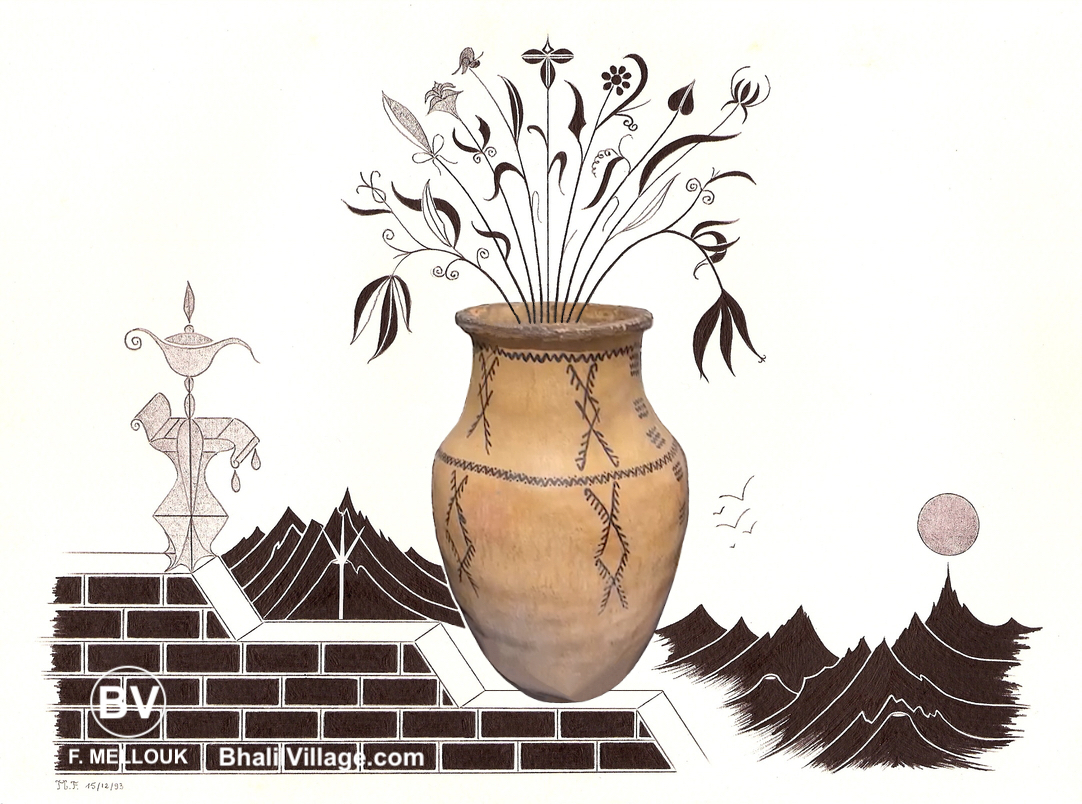
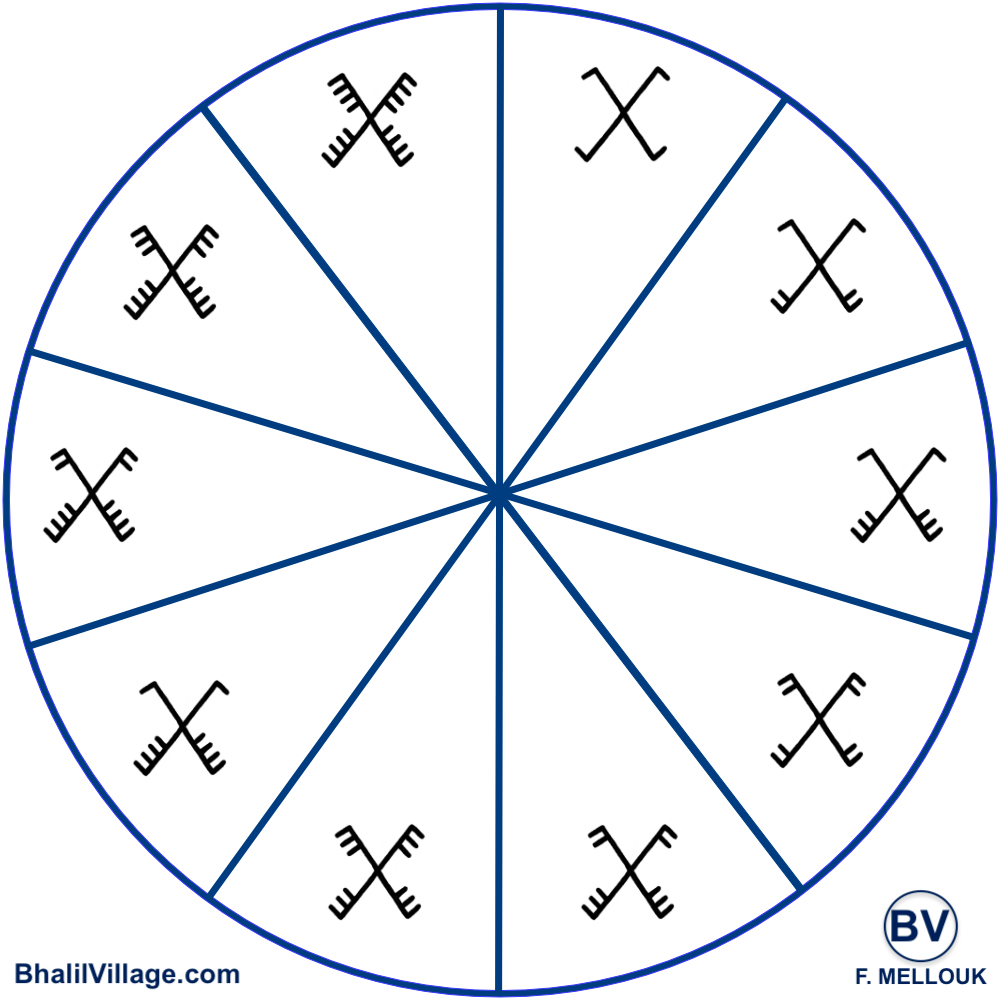
Symbol 1 - Integration into Drawing F. Mellouk (1993) - © 2026
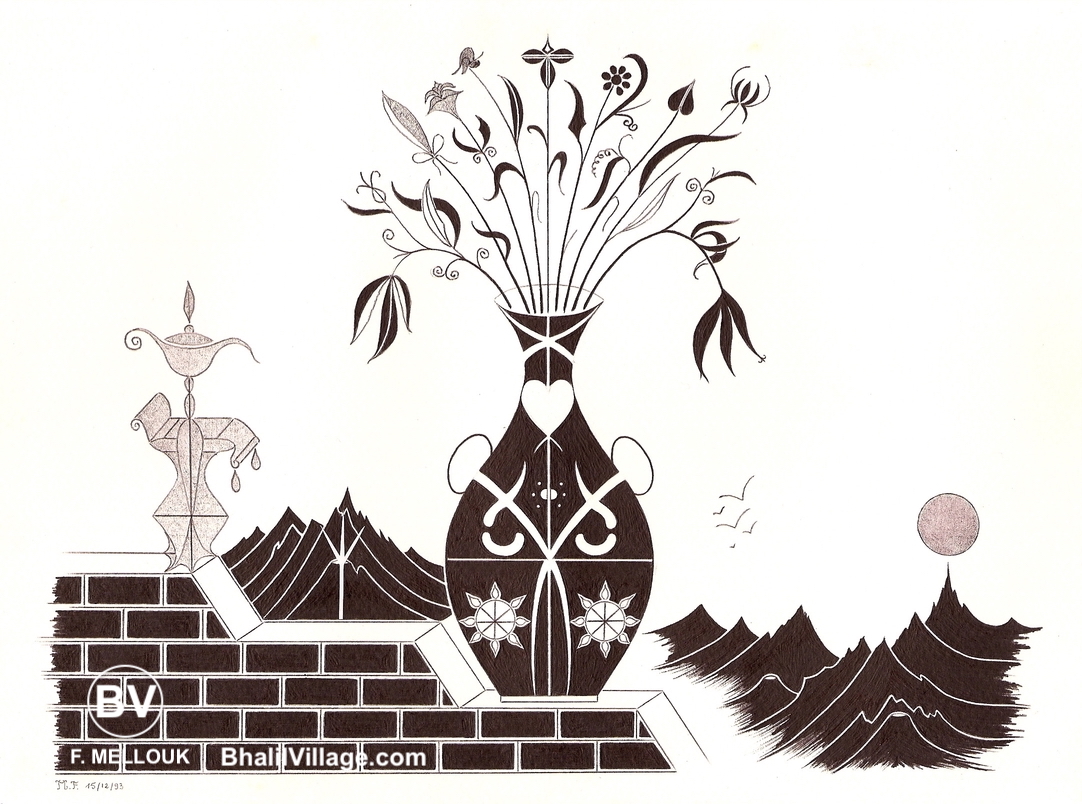
Symbol 2 - Original drawing by F. Mellouk (1993) - © 2026
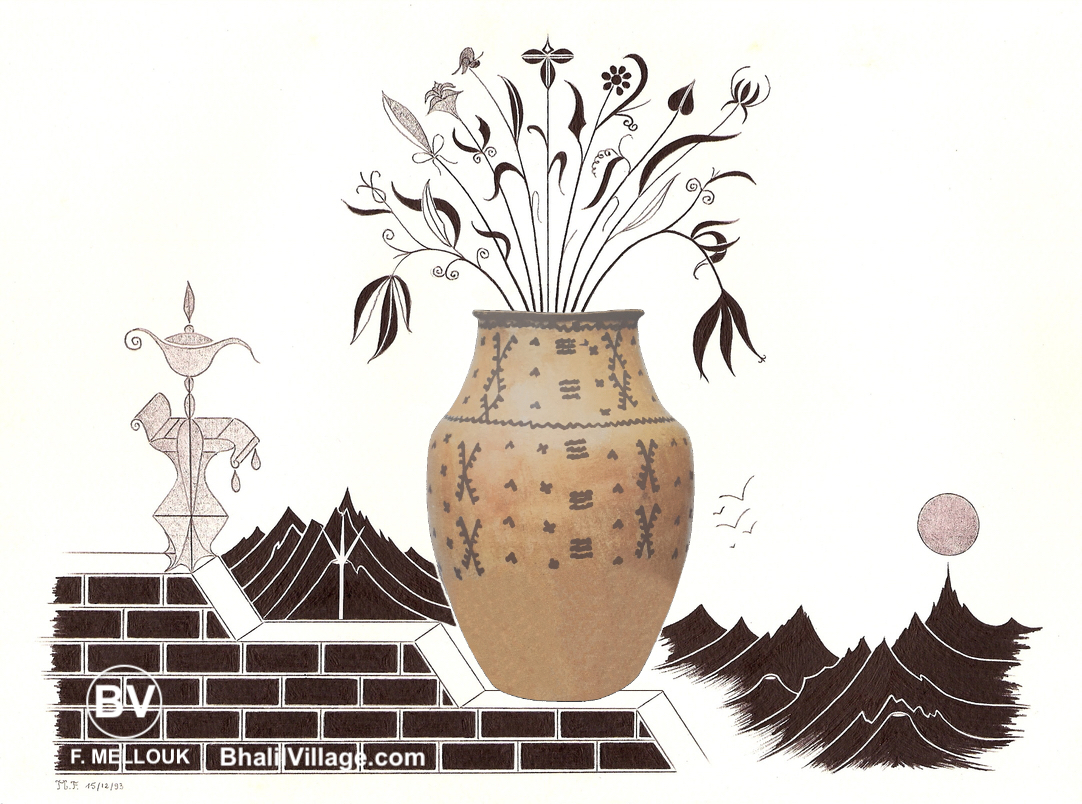
Symbol 3 - Integration into Drawing F. Mellouk (1993) - © 2026
🔵
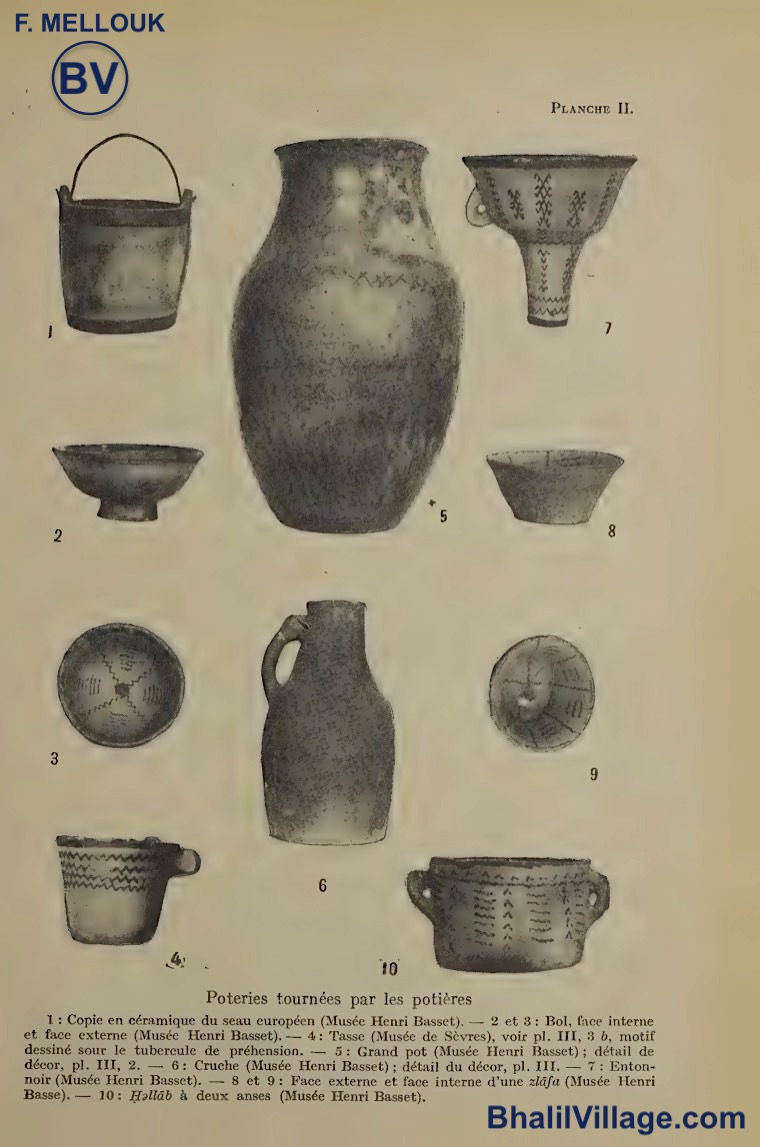
Pottery items made and used in Bhalil.
When one thinks of Moroccan pottery, one thinks of that from cities such as Fez, Salé, Safi, and so on...
But certainly not of that from Berber or Arab mountain villages like Bhalil. And yet there was
pottery in Bhalil. It was intended for local use, not for tourists. The aim was not to
produce pottery for decorative purposes, but to have items that met basic daily needs
such as providing a little warmth, storing food, cooking meals, eating
from a bowl... In short, earthenware household items.
For the Bhalil pottery, the practicality of the objects produced was a priority. The decoration on this pottery was kept to a strict
minimum and the use of colour was not the norm. The term “Tagueddart” is the local word for this
activity of producing rustic, minimalist and poorly made pots known as “Gueddours”. Hence the pejorative term
“Gueddour”, used to disparage a person, to belittle and reduce them to their physical or social status... rightly or
wrongly. Furthermore, the name “El Gueddar” may well mean “one who makes pots”.
Among the most commonly made and used objects by the people of Bhalil, there are some famous examples in the village:
➀
Majmar for cooking (works with charcoal). It has four holes on the sides. It is designed for small pots and teapots.
➁
Majmar for heating. It has no holes. You fill it with embers and use it as a space heater!
➂
Kanoun : A large, open-top Majmar with horns. Fuelled by logs.
It is suitable for large containers and is used to heat or cook larger quantities of food or water.
For example, it can be used to make Ramadan bread when combined with a large earthenware dish known as
“Ferrah”. For the bath, he heats enough water in a large copper container
(Barma). It is also used to heat a large metal sphere from the inside,
on which the famous “Tride” (very thin Moroccan pancakes).
➃ Quadra (or large pot) for water storage.
It is unglazed and of medium size (≈ 45 cm high), with a capacity of around 25 litres. It was used with an aluminium cup
called “Kachcoul” to help themselves to water.
➄ Casserole for a tagine or a casserole dish.
➅ Dish (a thick, deep plate with no rim).
➆ Bowl.
➇ Cup.
➈ Jup.
➉ Funnel.
⑪ Hallab (A container for collecting milk during milking).
⑫ Soldier's canteen.
⑬ bucket (ceramic, modelled on European designs).
⑭ Washstone (an accessory for scrubbing the body whilst washing).
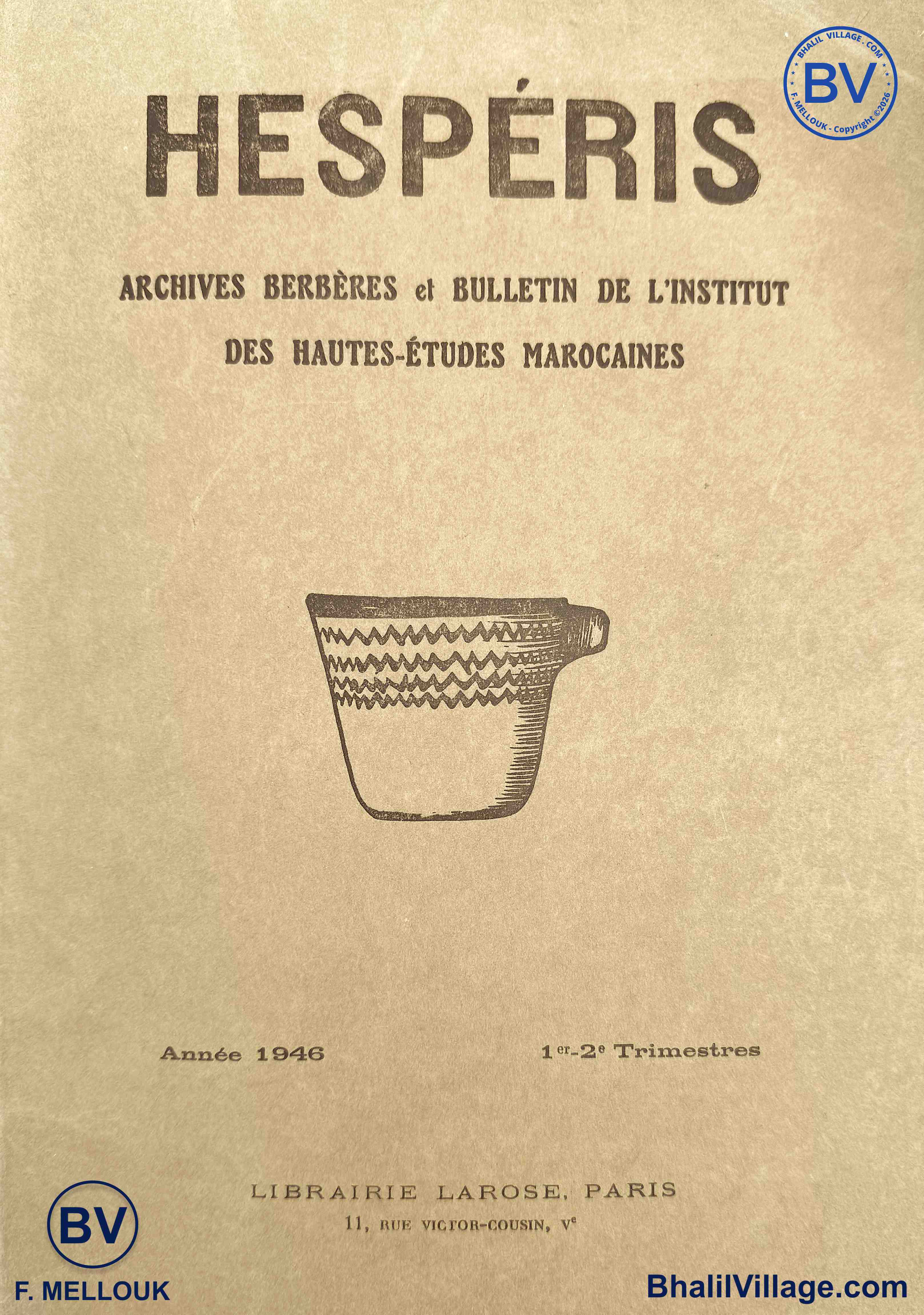
Most of this pottery produced in Bhalil has been described in an issue of the journal Hespéris in 1946
by Joseph HERBER (1873-1953). My favourite piece is the large pot and its decorations. On looking through
the entire original document, I realised that it is the Bhalil's ‘Coffee’ Mug with a closed handle
which was chosen for the cover. As for the exact meaning of the symbols featured on this pottery, one would need to delve into the world of
Berber symbolism in North Africa, and more specifically in Morocco. Below is a new presentation of some of the symbols found on Bhalil pottery, based on
the article in the journal Hespéris for drawings nos. 1 and 3, and a personal summary for drawing no. 2.
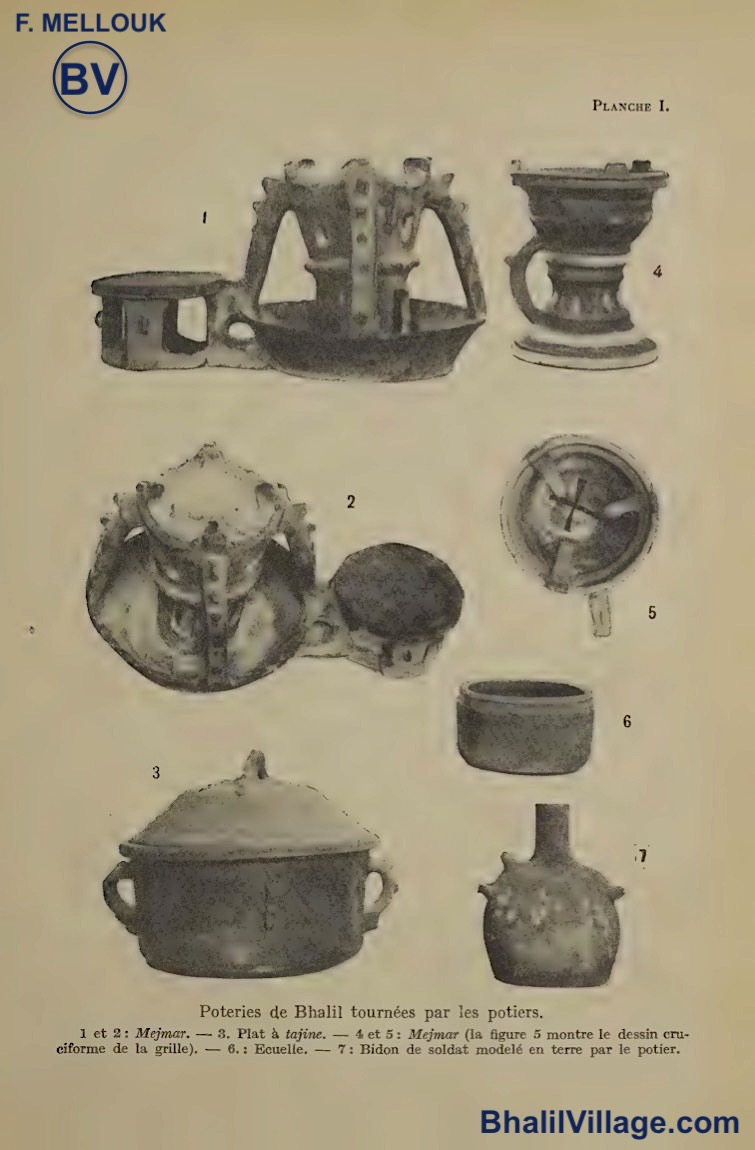
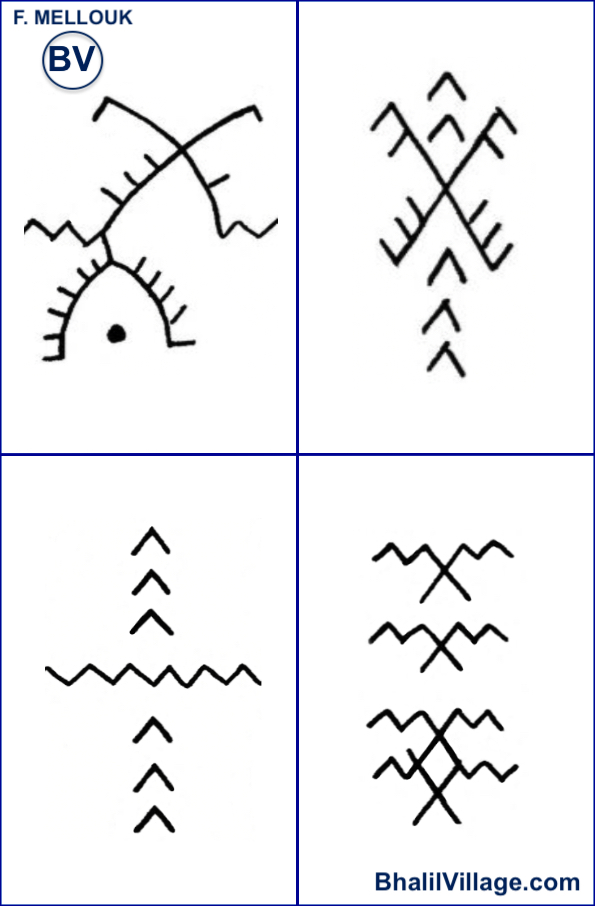
Illustration : F. Mellouk © 2026 - Hespéris
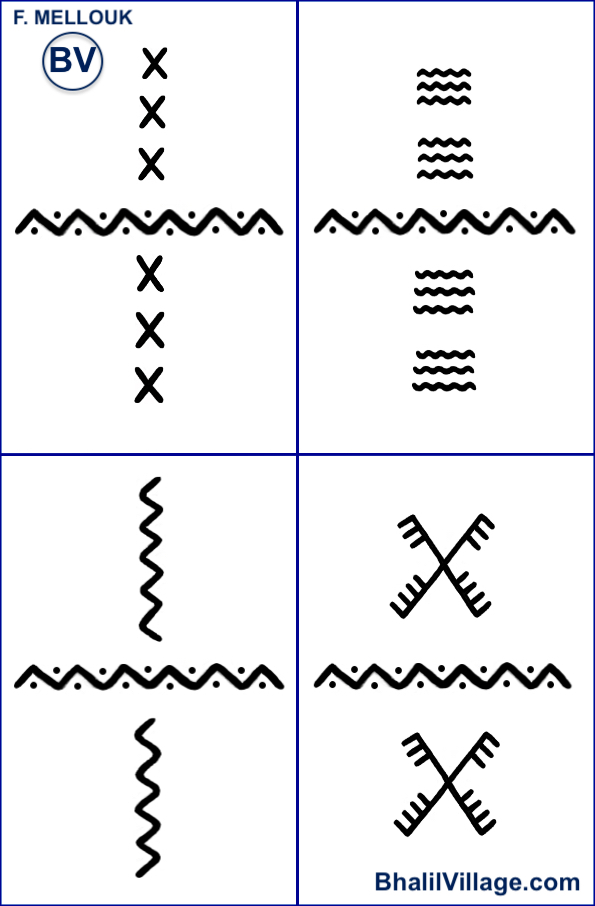
Illustration-Drawings : F. Mellouk © 2026
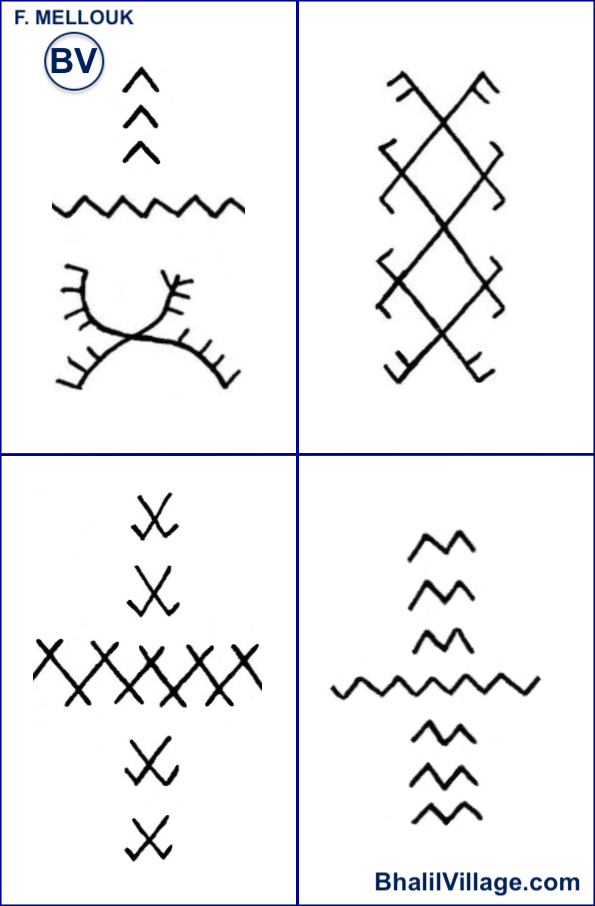
Illustration : F. Mellouk © 2026 - Hespéris
🔵
Pottery items used in Bhalil but not made there.
As for the other items used in Bhalil but not made in the village, here are a few examples:
➀ Khabia Khabia (Small or medium-sized jar - Height ≈ 50-70 cm -
Width ≈ 20-25 cm - Capacity ≈ 15-30 litres). It is glazed on the inside and can be used, for example, to store oil, water, or even milk
for the traditional production of butter and buttermilk, or “Lben”. The latter is much loved by the people of Bhalil, especially when
drunk mixed with some good steamed semolina! In this form, it really gives mint tea a run for its money.
➁ Zir (Large jar - Height ≈ 70-75 cm and above - Width ≈ 25-50 cm -
Capacity ≈ 30-60 litres and above). It is sealed with a leather lid known as an “Amadoun”, which is locally made and
custom-fitted for the ‘Zir’.
To make the Amadoun, the leather is stretched
over the Zir’s closure and secured with string. It is then left to harden, resulting in a custom-fitted lid. The Zir is usually large
in size. However, it can also be medium-sized. It is glazed on the inside. It is used to store olive oil.
However, medium-sized Zirs can also be used to store water. When the zir is filled with
olive oil, it is essential to ensure it is tightly sealed to prevent a mouse from falling in and
ruining the harvest and dealing a blow to the family finances. A moment of carelessness
that inevitably deals a heavy blow to the family finances. On this subject, a local proverb says:
‘Sikh Bel Khabia Ftent El Far’ (Translation: sacrifice the oil because of the mouse).
➂ Ferrah (a large dish used for baking Ramadan bread).
Sold to Bhalil by people from “Ouled El Haj” (a local tribe whose main town is “Outat El Haj”). It is therefore assumed
that it was made in “Outat El Haj”.
➃ Kasaâ (a large serving dish for couscous...)
🔵
What about the cutlery?
When taking stock of the pottery used in Bhalil, whether produced locally or imported from other regions, I naturally pointed
out that there were no plates for individual servings, nor any forks or spoons made of terracotta. As for plates, the explanation
is relatively simple: to this day, almost everyone in Bhalil eats with their family from the same large plate and, at the same time,
drinks from the same glass. As for forks and spoons, the people of Bhalil eat with their hands and drink soups directly from the
bowls without needing spoons. The issue is therefore resolved in the traditional way, at the expense of a few hygiene rules.
Under these circumstances, it is obviously advisable to wash your hands thoroughly with soap before sitting down to eat.
Currently, these customs are gradually becoming more modern over time. Furthermore, it is more difficult in everyday life to cut
things with your hands or teeth. Consequently, I believe that knives and scissors, as well as other sharp objects, must have become
commonplace quite early on among the villagers. The invention of knives dates back to the Stone Age and that of scissors to the Bronze
Age, well before the Iron Age. In the meantime, perhaps it would have been necessary to make some wooden cutlery. There was no shortage
of oak in the region, and it had been put to good use in making a fair number of objects and in the timber framing of houses in Bhalil.
🔵
Production techniques.
First of all, a source of clay was needed as a raw material. It was in the lower-lying areas of Bhalil that this malleable material,
which could be kneaded at will, was most readily available. Higher up, it was (and still is) Jurassic limestone that predominates.
Evidently, the male potters of Bhalil went to fetch their clay further afield, whilst the female potters obtained clay in the immediate
vicinity of Bhalil, such as near Abiyata-Binlajraf towards the road to Sefrou. This means that not everyone used the same clay.
Sometimes pieces of a broken Majmar were mixed into the clay (Afrour) intended for recycling. These pieces are
thoroughly crushed and reincorporated into the clay to build a new Majmar. The rest of the production process is purely technical:
crushing and sieving the clay, mixing it with water, kneading, shaping, throwing on the potter’s wheel, sun-drying and oven-baking
(El Hamya). This final stage, which can last three or four days, or even longer, involves a kiln that is itself made
locally from pottery clay and fuelled by logs. It is also an occasion for a festive ritual among members of the community (family,
neighbours, etc.). The atmosphere of fire and smoke attracts many children who come to watch the blaze. They instinctively sense the
prospect of a hot meal at the end of the day! The manufactured items will be sold later for a few coins (Rials),
which will help to replenish the household's funds.
In Bhalil, pottery made by women differs slightly from that made by men. Although the shape of the women’s pottery is imperfect
(as it is not wheel-thrown), the finish is noticeably smoother. As one might expect, the technique in Bhalil remained traditional,
even ancestral, with a few distinctive features.
🔵
The decoration of Bhalil pottery.
The decoration on the pottery is Berber-inspired, as is the case with tattooing and weaving. However, it seems that it was the
decoration found in weaving that inspired that of the pottery and tattooing. At least in the case of women’s pottery. The scarcity
of ancient pottery pieces still present in Bhalil does not allow for a comprehensive analysis of the symbols used in this decoration.
Hence the reliance on bibliographical sources that have already dealt with this pottery. This inventory has been supplemented by a
few personal observations, resulting in the description provided above. However, I have observed that sometimes the same symbol can
take on several forms. Through imagination and extrapolation, here are some possible examples of variations of the “
Saw or Cross” that were probably used by the craftsmen of the time.
A comprehensive study of the decoration of Bhalil pottery would make it possible
to reconstruct at least part of this lost pottery.
🔵 The future of pottery in Bhalil. These days, we see less and less pottery in Bhalil, whether it is made or simply used in the village. I think that, as it was pottery intended for practical use, it has been replaced by contemporary, industrial ‘tools’ that have entered the local market. Development has taken its toll. However, one can occasionally come across a few pieces of old decorated pottery in the collections of private collectors. It would appear that the decoration of Bhalil pottery began to disappear at the same time as the tattooing of faces and hands among the village women, from the middle of the last century onwards. The pottery trade, once practised in Bhalil, seems to have died out. And with it, the crafts associated with this activity. I would like to pay tribute to all the potters who kept this craft alive in those days, no doubt in every neighbourhood of Bhalil. Among them were two women I remember well, as they were close to the family and lived in the Aghezdis neighbourhood: Aïcha Errachia Derkiba, and Khdija El Haouma Hammia. May God rest their souls.
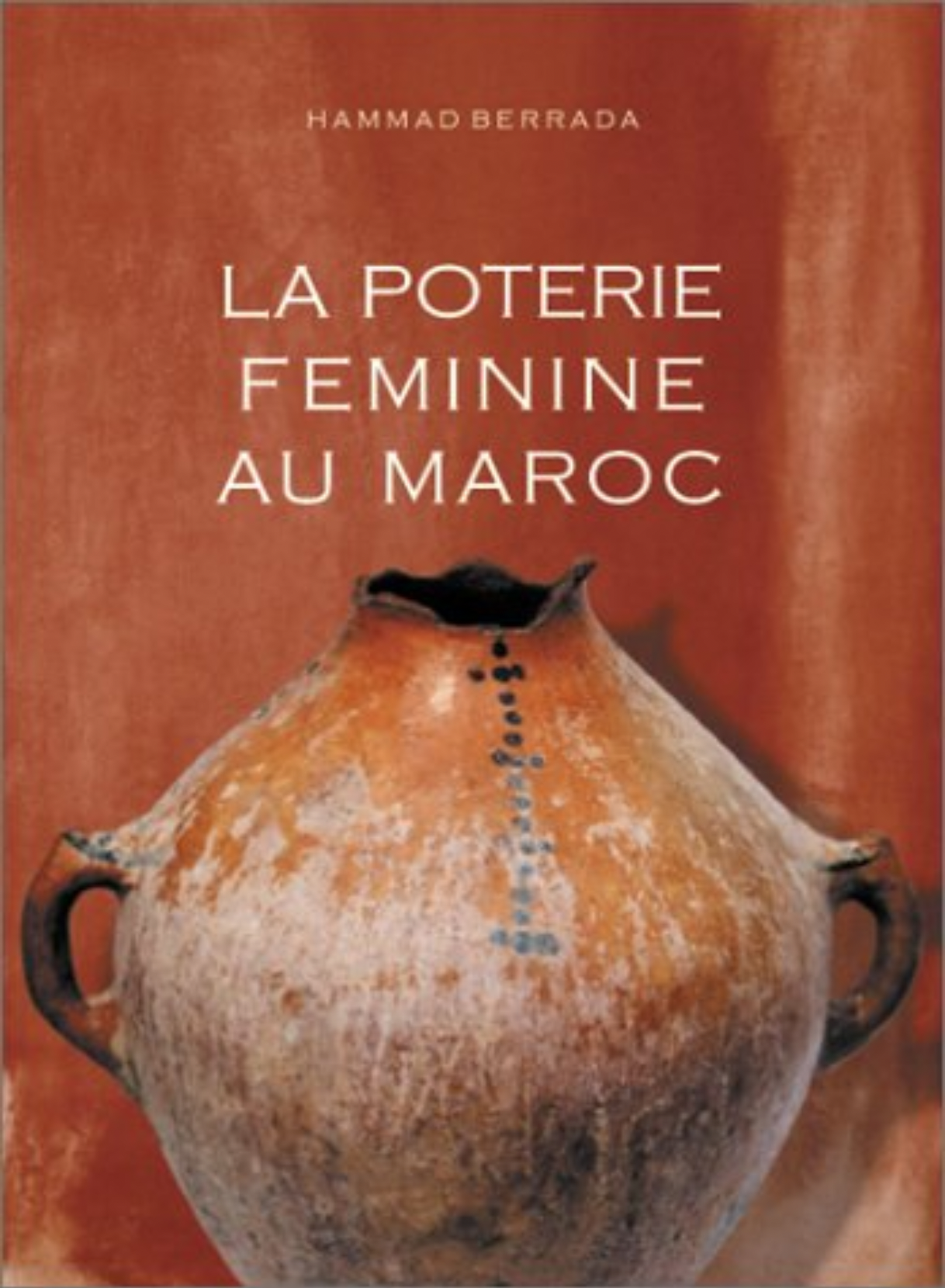
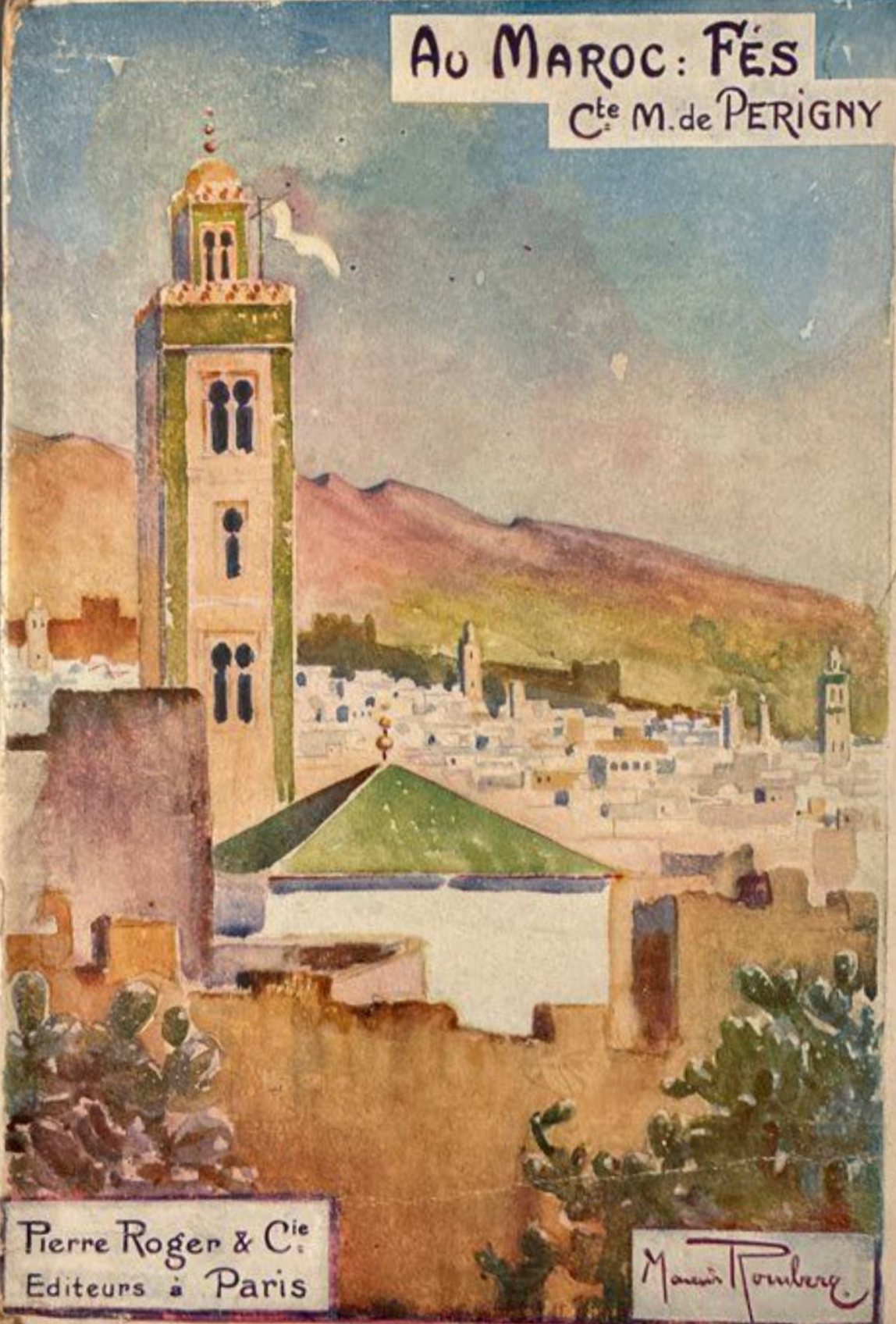
🔵 Bibliography ➀ Notes sur les poteries de Bhalil. Hesperis : Archives berbères et bulletin de l'Institut des Hautes Etudes Marocaines - Joseph Herber - 1946 ➁ Technique des poteries rifaines du Zerhoun. Hesperis : Archives berbères et bulletin de l'Institut des Hautes Etudes Marocaines - Joseph Herber - 1922 ➂ Contribution à l’élude des poteries Zaër. Hesperis : Archives berbères et bulletin de l'Institut des Hautes Etudes Marocaines - Joseph Herber - 1931 - T13 - P19 ➃ La poterie féminine au Maroc. Editions Publiday-Multidia - Casablanca - Printed in Espagne - Hammad Berrada - 2002 - Reissued in 2016 in a bilingual French-English edition. ➄ La poterie masculine en milieu amazighe. IRCAM - 2011 - Revue 6 ➅ La céramique de tradition amazighe. IRCAM - 2011 - Revue 6 ➆ Poterie rurale en Afrique du nord. OpenEdition Journals - Encyclopédie berbère - Pierre Guichard & Ernest Hamel - 2015 ➇ Exposition : La poterie...au féminin. Finances News Hebdo - Culture & Société - 14.03.2023 ➈ Au Maroc : Fès - La Capitale du Nord. Ed. Pierre Roger & Cie - Paris - Comte Maurice de Périgy - 1919 - P231 ➉ Le Maroc et ses Villes d'Art . Éd. H. Laurens - Paris - Pierre Champion - 1927 - Partie 1- P87 ⑪ Guide de la culture berbère . Éd. Paris-Méditerranée. Paris ; Ina-Yas. Alger - Mohand-Akli Haddadou - 2000 ⑫ Petit Guide des Catégories de Symboles Amazigh. Instagram - Mayasanaa. ⑬ Artisanat berbère - Signes et Symboles. ChroniquesAlgeriennes.Unblog.fr
HESPERIS 🔹 ARTICLE 19 🔹 RESOURCES 🔹 TOP OF PAGE
PRODUCTION & DESIGN: Fouad MELLOUK ☀ DATE OF PUBLICATION: April 22, 2023 ☀ UPDATE: January 01, 2026 ☀ CATEGORY: Discovery - History - Memory - Memories ☀ DOCUMENTS, IMAGES & TEXT: All rights reserved. No reproduction without express permission ☀ CONTACT: bhalilvillage@gmail.com ☀ COPYRIGHT © 2023