


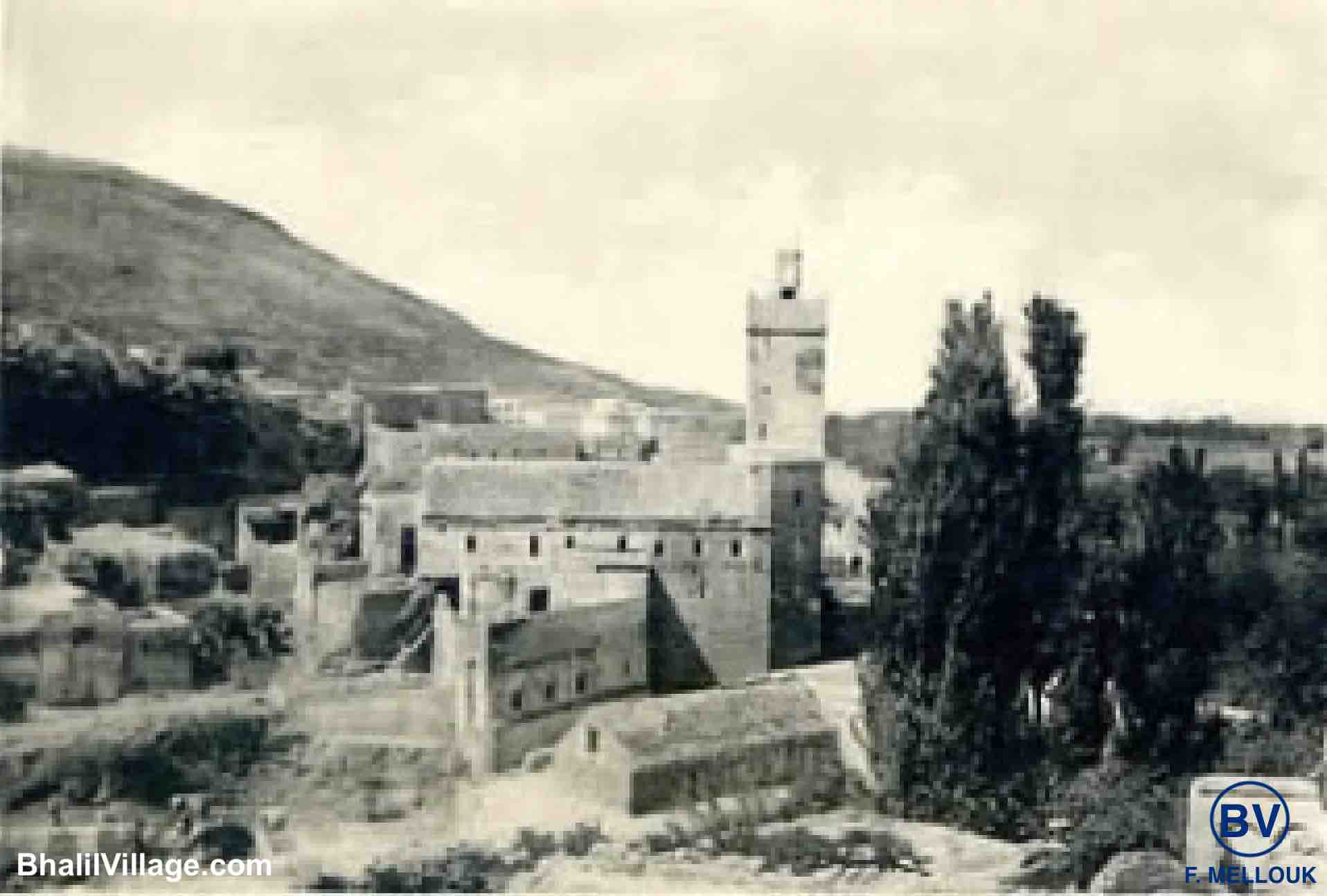
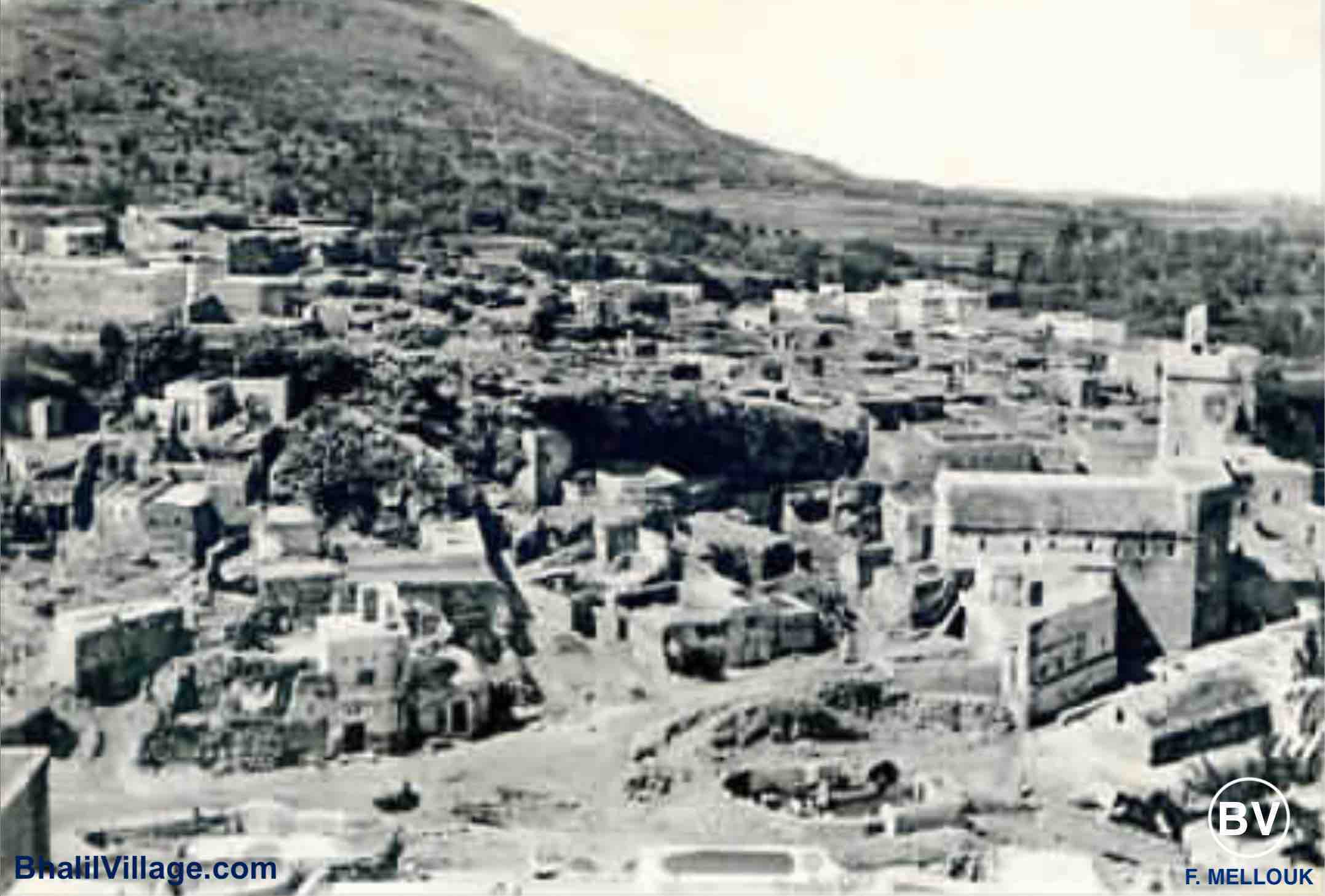
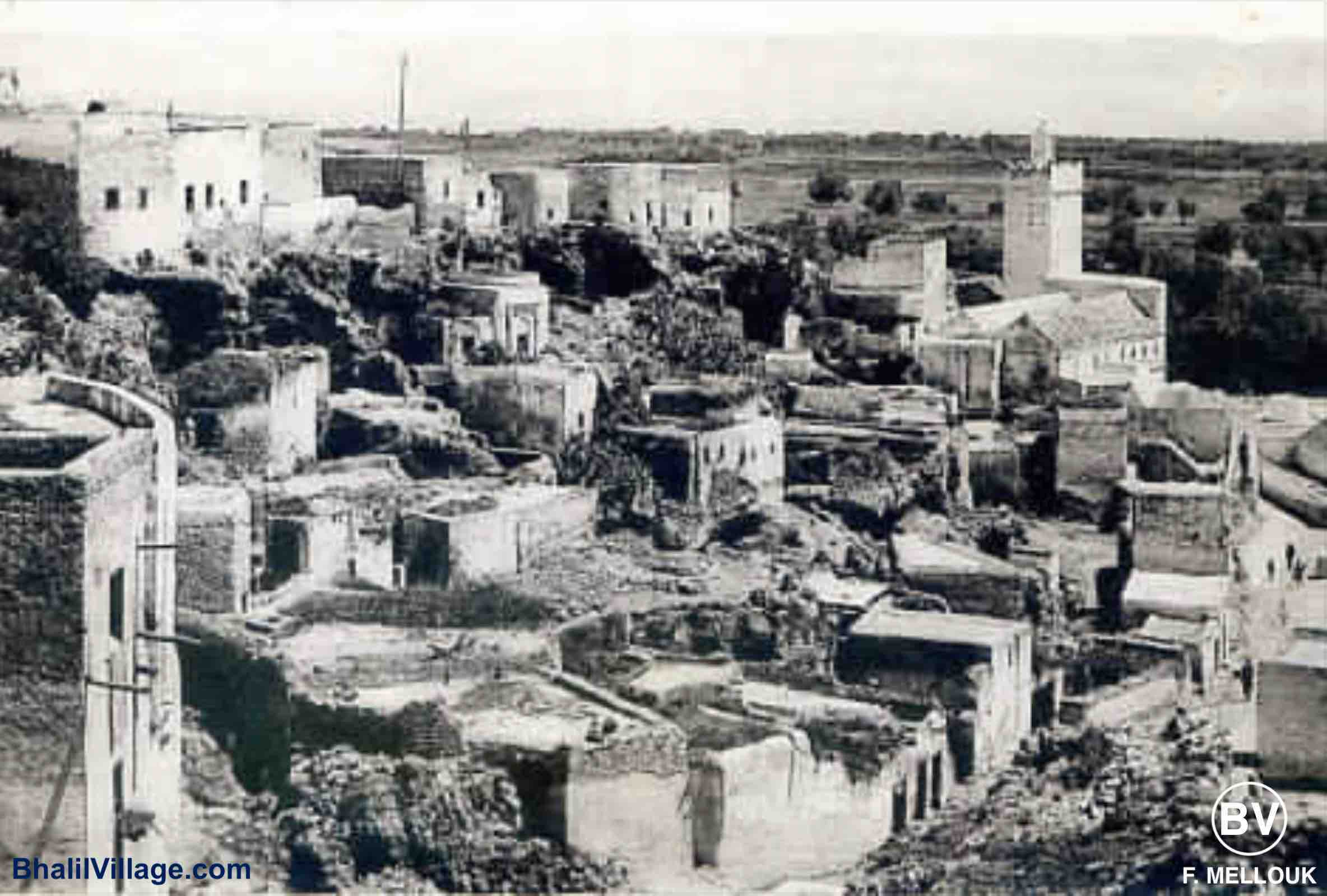
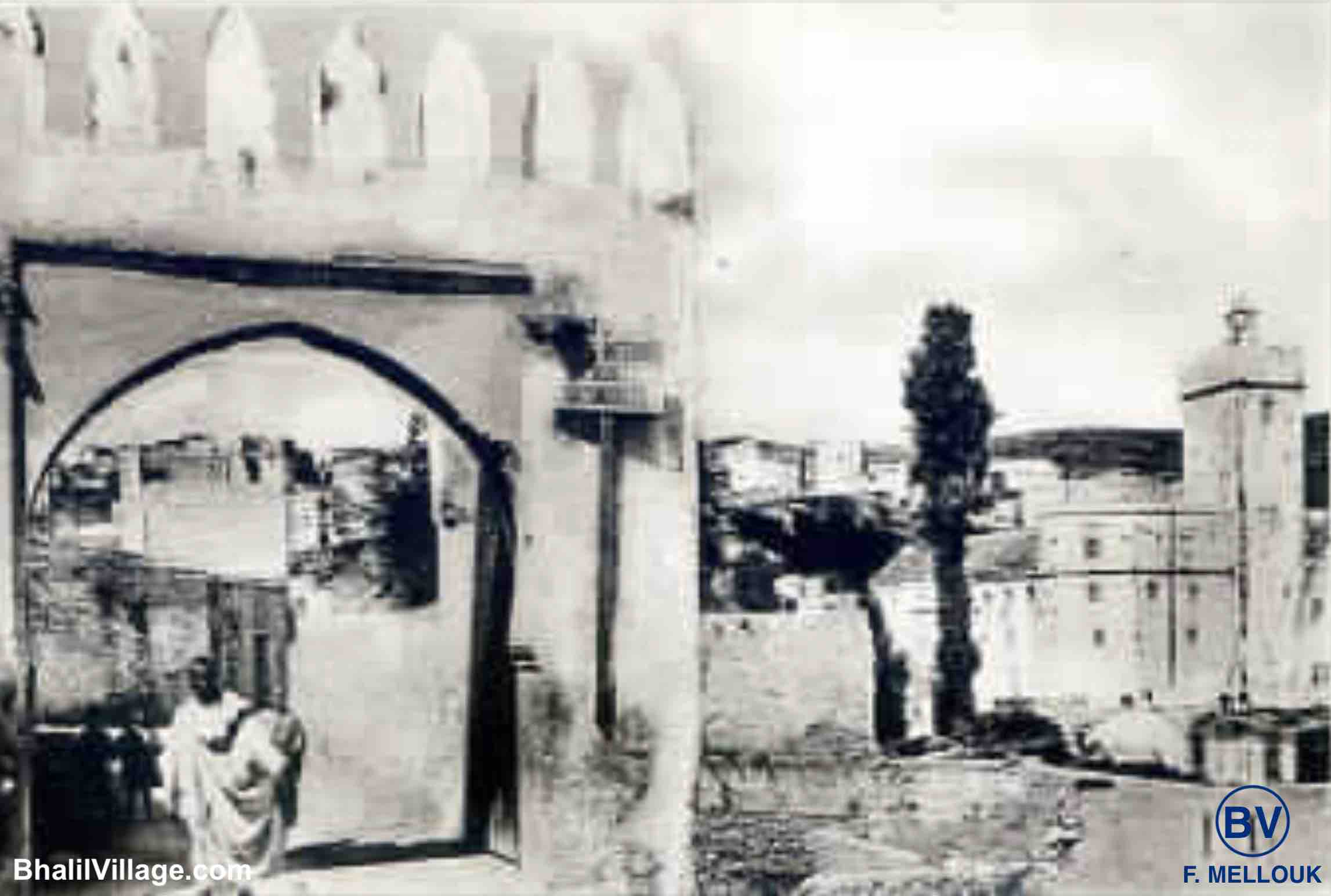
BHALIL: Historic centre. Old postcards dating from the early 20th century. Probably around 1915.
It is unclear where the name Bhalil comes from. However, there are three versions
according to Wikipedia article :
➀ Historical sources cite the name of the Berber tribe ‘Bahloula’ or ‘Bani Bahloul’ as the origin of the name Bhalil.
➁ Mythological sources, where Judeo-Christian religious references are emphasised during the reign of Moulay Driss II:
The Muslims of Sefrou said that the people of Bhalil were stupid, foolish and simple-minded.
➂ And finally, the etymological sources where popular belief translates the name Bhalil into the nickname ‘bahaoullayl’
, which means ‘charm of the night’.
The people of Bhalil are said to have come from the area around Bhalil (a few kilometres from the historic centre). Traces of human life or small population centres still exist in the vicinity of Bhalil in areas known as ‘Tchours’. These include Tchar Chkounda, Tchar Boumarâz, Tchar El Kalaâ, Tchar Zouawa, etc. It seems that all these people eventually came together and settled in the same place, namely Bhalil. A few decades ago, everyone knew everyone else in Bhalil. This is still somewhat true today. The village has expanded beyond its historical boundaries. The inhabitants of Bhalil, who were beginning to have a little money, built outside the fortifications and people began to talk about ‘going outside’ or ‘going inside’. As if you could go outside inside or inside outside ! In short, with the rural exodus underway, many people came to settle in the village. At the same time, many locals have moved away. Based on family names, it is sometimes possible to deduce where they come from. Many names have geographical connotations, etc. In any case, the people of Bhalil are Bahloulis and Bahlouliyates (Bahlouli and Bhalouliya in the singular) . In Bhalil itself, the inhabitants do not really read Wikipedia. The historical version of their origin is therefore not really circulated, and they do not seem interested in it. However, depending on whether or not one mocks them , one will remember either the mythological version or the etymological version. In everyday life, people don't care too much about where they come from. They have other things to worry about! They are not rich, except perhaps a few, and the environment is rather modest. But as someone said about the history of people in general: ‘the poor have no right to memories’.
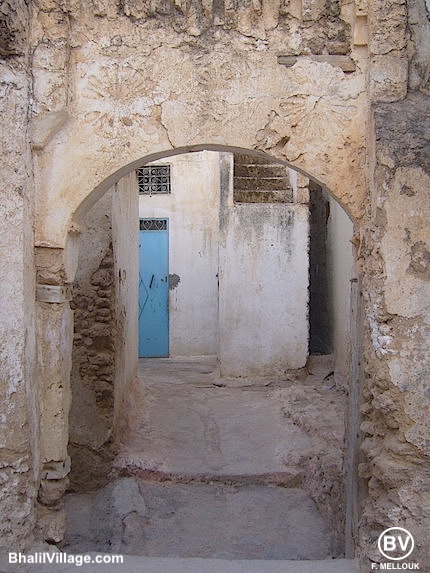
Remains of an alleyway entrance. 2009 - © 2023
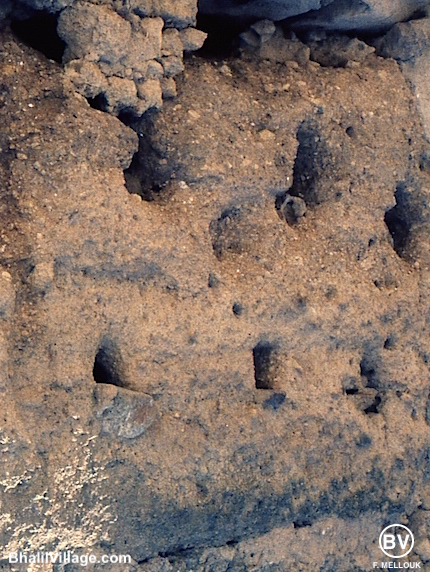
Entrance to the neighbourhood (Derb) ≈ 1988 - © 2023
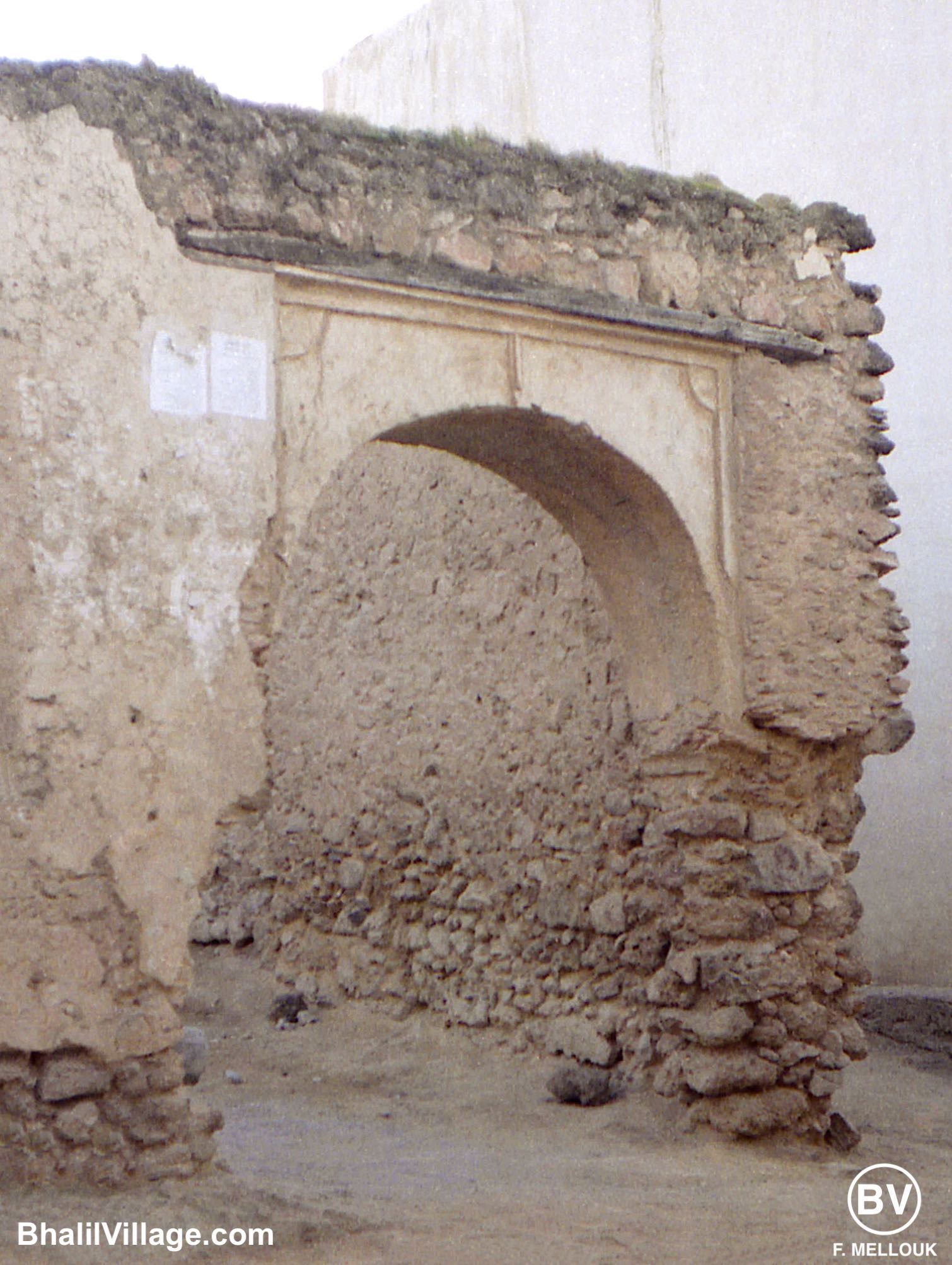
Remains of an old wall. 1991 - © 2023
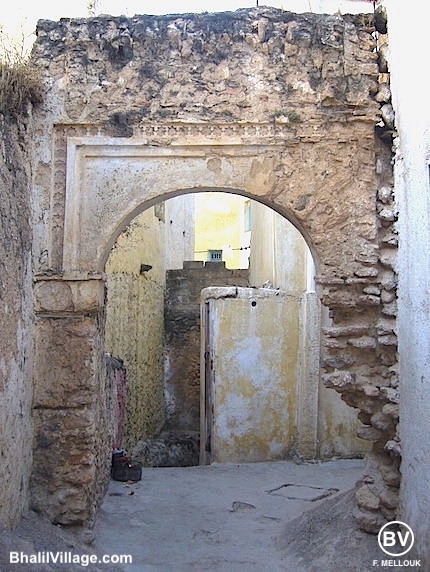
Remains of an alleyway entrance. 2009 - © 2023
Bhalil was enclosed by fortifications that have now almost disappeared. Like all fortifications, they served to protect against enemy attacks. The entire village, with its fortifications, was surrounded by a wide belt-shaped path. Over time, this path became a track that was more or less suitable for cycling. It was mainly used by pedestrians and livestock. There were hardly any cars, let alone lorries. Over time, the track became a small tarmac road in the 1970s and 1980s. We are not talking here about a 10 cm thick layer of tarmac, but a small 3-4 km road that develops potholes in good weather and rain. You always need good shock absorbers to drive in Bhalil! Otherwise, in the past, you had to be equipped with locally made sandals called ‘El Gamouss’ or ‘Michlana’, in reference to the soles made from old Michelin tyres. A local version of a 4x4, made for pedestrians (especially for people who worked in the fields).
It is therefore likely that the presence of water sources, cliffs and caves led to the choice of this location for settlement. Fortifications and cave dwellings were added to the site to consolidate the settlement. According to the elders, raids were organised in the region by rival tribes who pillaged each other. People got by as best they could. At the foot of the mountain, the farmland is neither extensive nor particularly fertile. The area is not a crossroads conducive to trade and commerce. Rather, it is a place that is relatively isolated from major roads. But people felt safe and secure in the cellars and caves.
It is difficult to draw any clear conclusions about the history and origins of the people of Bhalil. However, I think it is possible, by reading what has already been written in the literature, to form a general idea of Bhalil's historical place (at the local level) over the past centuries. Personally, I have not done so. I leave that work to historians and people who are more interested in it. Simply, as someone who has lived in Bhalil, I feel that we do not know exactly when the first people came to settle and found Bhalil. Nor whether they really came from the immediate vicinity (Tchours). And even if we assume that this is true, then where did the people of the ‘Tchours’ come from? It is said that Tchar Chkounda was inhabited by the Roman seconda. And Tchar Boumarâz? Etc... One thing seems certain: traces of human activity in these ‘Tchours’ tend to disappear over time. In the 1980s, there were still limestone wheels in Tchar Boumarâz that were used in oil mills. It seems that they are no longer there. In Aïn Gzal, there was a large stone that sounded like metal when you tapped it. Women used it to wash their clothes on. One day it disappeared. When we walked through the fields, we would sometimes come across the perfect imprint of a jar that had been broken. These mysteries have never been solved. Excavations in the ‘Tchours’ near Bhalil, officially carried out at the Request from two local associations (Massarat Association for Mountain Tourism Development and Les Amis de Bhalil Association) provided some answers. But nothing noteworthy in terms of discoveries. Here is the Archaeological Excursion Report dated 14/07/2011, written following these excavations. Furthermore, the ‘treasure’ found in El Kalaâ by people whose faces we never see and who do not even mention the place in question... (I won't put the link to the YouTube video here), looks more like a scam than anything else. What, for example, is a brass figurine of a dromedary doing at the top of El Kalaâ? I won't even mention the ‘tweaks’ that can be made during video editing... In short, many people today still remember the ancient artefacts sold in Bhalil in the 1970s and 1980s to people who had no qualms about reselling them in the bazaars of major tourist cities. There are probably still many hidden things to discover about and in Bhalil. Unfortunately, it takes time and investment. Let's imagine for a moment that all these lost objects ended up in a museum in Bhalil! It could have served to boost tourism in the village. Of course, I am neither the first nor the last to see the problem from this angle. But it cannot be repeated often enough. Perhaps it is difficult to go very far back in Bhalil's history based on simple objects. But every object tells a story. And it is better to tell stories based on objects. If there are no stories to tell, there will be no history at all. As the saying goes: those who ignore their history are doomed to repeat it.
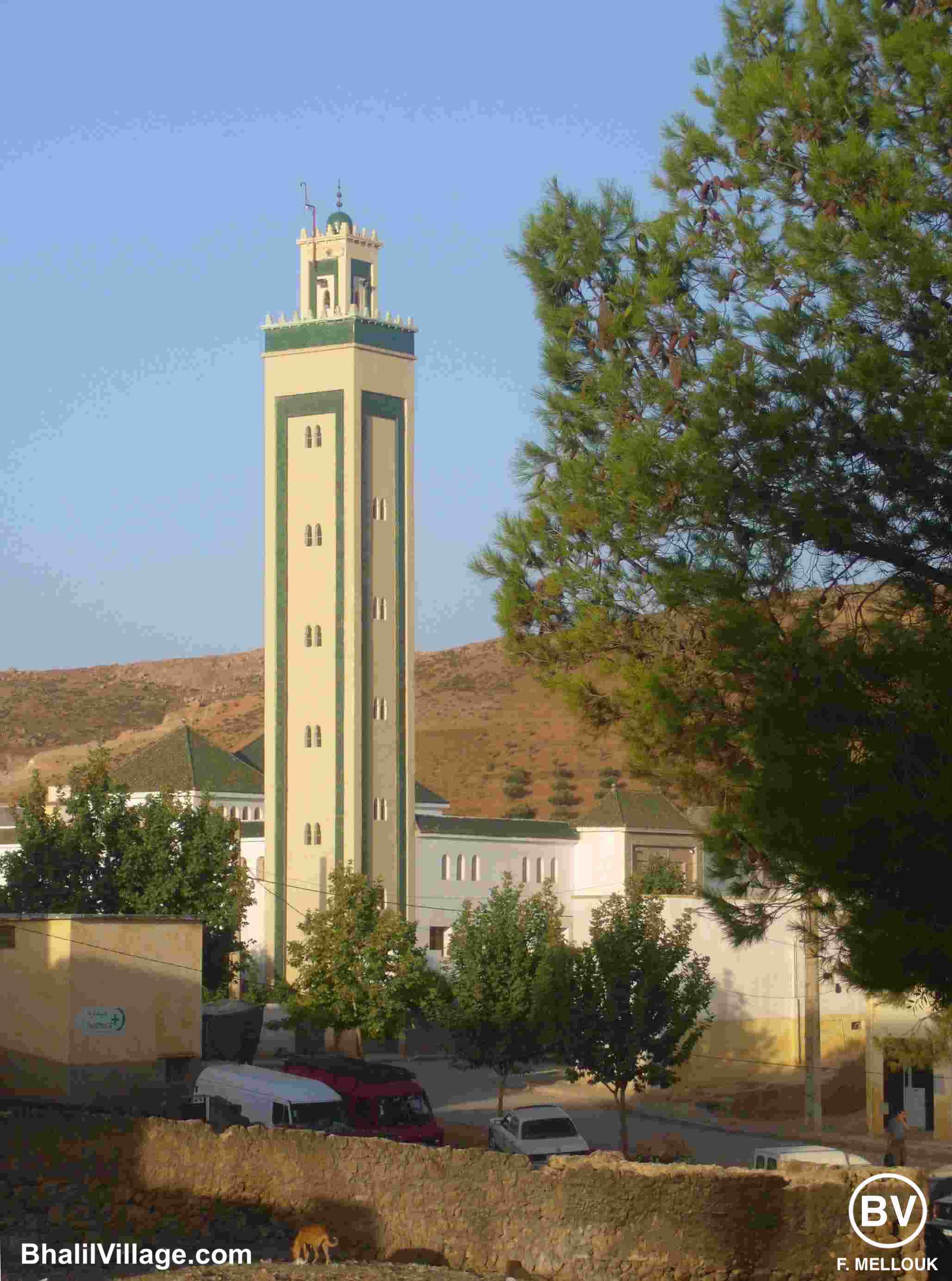
and new economic centre. 2009 - © 2023

still standing with its roof intact. 1991 - © 2023

in ruins. It looks like a church! 2009 - © 2023

He's building his minaret! 2009 - © 2023
🔹 At the beginning of the 20th century, and more precisely on 5 June 1911 in the vicinity of Bhalil Village, a battle took place between the French army and the local resistance to the occupation. This battle is better known as the ‘Battle of Bhalil’. For more information, visit the special free web page at: ‘The Battle of Bhalil’.
HARVARD 🔹 TOPOGRAPHY 🔹 RESOURCES 🔹 TOP OF PAGE
PRODUCTION & DESIGN: Fouad MELLOUK ☀ DATE OF PUBLICATION: April 22, 2023 ☀ UPDATE: May 20, 2024 ☀ CATEGORY: Discovery - History - Memory - Memories ☀ DOCUMENTS, IMAGES & TEXT: All rights reserved. No reproduction without express permission ☀ CONTACT: bhalilvillage@gmail.com ☀ COPYRIGHT © 2023